How to choose payroll software in Egypt (2026)
An honest checklist for choosing payroll software in Egypt: what the law requires, what to ask in a demo, and how the main types of solution compare.
By Mostafa Wanas, founder, Wanas Apps
Published: | Updated: | 8 min read
Figures verified on 22 Oct 2026
Payroll looks simple until the first month it is wrong. In Egypt the rules move every January, the tax authority now expects a monthly payroll tax form, and a payslip has to be right in two languages for a workforce that may be paid by several banks. This guide is a checklist you can take into any demo, whether you are replacing a spreadsheet or an older system.
It is written by the team behind Wanas Payroll, so we say plainly where we fit and where we do not. The checklist applies to any product you consider.
1. Statutory coverage: the part you cannot compromise on
Ask the vendor to show each of these working on a real example, not to tick a box on a slide.
- Social insurance, Law 148/2019. Employees contribute 11% and employers 18.75% of the insurable wage, which is clamped between a minimum and a maximum. For 2026 the limits are EGP 2,700 and EGP 16,700 a month, and they are revised every January (published by NOSI). Check that the tool clamps the wage, handles partial months, and keeps the limits in an effective-dated table rather than in a formula.
- Income tax, Law 7/2024. An EGP 20,000 personal exemption, then progressive brackets from 0% up to 27.5%, a phase-out of the lower brackets for high incomes, and the annual taxable base rounded down to the nearest EGP 10. Ask how the tool annualises a monthly salary and what it does for a mid-year joiner.
- Universal Health Insurance (UHI) and the martyrs' fund (0.05%). Many tools skip these two. UHI applies by governorate as the Universal Health Insurance Authority rolls the scheme out, so the tool needs a setting for it.
- The ETA unified payroll tax system. Since 15 December 2024 every employer has to calculate salary tax through the Egyptian Tax Authority's monthly calculation form, and the tax is due by the 15th of the following month. The forms the authority generates for you later (quarterly and annual) all come from those monthly forms. A good payroll tool tags every earning and deduction with the ETA code, and ideally produces the file in the ETA layout. Ask exactly what is automated and what you still retype.
- NOSI forms. Registering a new hire, reporting a wage change and reporting a leaver (the Forms 1, 2 and 6 your HR team knows) should at least produce clean data lists, even if the filing itself happens on the NOSI portal.
Then ask the question that separates good from fragile: when the January limits change, who updates the rules, how fast, and can you see which rule set was used for last March's run? Versioned rule sets with effective dates are the right answer.
2. Attendance and leave integration
Most payroll errors start before payroll: a missing check-out, a leave request nobody entered, a holiday that was not applied. If attendance, leave and holidays already live in an HR system, the payroll tool should read them directly and show you the exceptions, instead of asking for a spreadsheet each month. Check whether late arrivals, unpaid leave and overtime turn into pay lines by rule, and whether you can override a single employee with a reason.
3. Approvals and an audit trail
A payroll officer should not be the only person who can release salaries. Look for a pay run that moves through states (draft, calculated, approved, locked, paid), approval rules that can require a second person, and an audit log that records who changed a salary or an adjustment and when. This matters for your auditor as much as for security.
4. Bank files
Egyptian companies usually pay by bank transfer files uploaded to the bank portal. Ask which banks have a named layout, whether the layout can be edited, and whether the file is validated before you download it. Whatever the answer, confirm the layout with your own bank before the first real transfer.
5. Arabic payslips
Your employees read payslips, not dashboards. A payslip should print in Arabic, in English, or both, show the calculation lines in plain words, and let an employee open only their own. If the product is "Arabic support" but the payslip PDF is English-only, you will end up building your own template.
6. Pricing: per employee or flat?
Per-employee pricing is easy to understand and punishes small, growing teams: the invoice moves with every hire, and extras such as payslips, bank files or an API are often priced separately. A flat price per company, banded by headcount, is easier to budget. Whatever model you see, ask for the all-in monthly cost for your headcount today and in two years, and for what happens above the band.
As a reference point, at 50 employees a flat plan of EGP 1,500 a month is EGP 30 per employee, and at 100 employees it is EGP 15. Do the same arithmetic on every quote.
7. Data protection: Law 151/2020
Payroll holds national IDs, bank accounts and salaries, which makes it the most sensitive data in an HR stack. Egypt's Personal Data Protection Law 151/2020 applies. Ask where the data is hosted, whether sensitive fields are encrypted, how access is separated by role (administrator, payroll officer, employee), whether every sensitive action is logged, and how you can export or delete your data if you leave.
How the main types of solution compare
There is no single best answer; the right type depends on your headcount, your existing systems and who owns payroll. This table compares types of solution, not specific products.
| Type | Where it works well | What to check for Egypt |
|---|---|---|
| Excel and an accountant | Very small teams, simple pay, an accountant who knows the rules and reviews every month. | Formulas silently go stale when limits change; no approvals or audit trail; payslips and bank files are manual; the ETA form is typed or pasted each month. |
| Desktop payroll package | One office, one payroll operator, no need for remote access. | Who updates the statutory rules each January; whether employees can get payslips without the operator; backups and multi-user access. |
| Regional HR suite | Companies that want one HR platform across several countries, with a vendor team to configure it. | Depth of the Egypt module (UHI, martyrs' fund, Law 7/2024 phase-out, NOSI data); quote-based pricing; implementation time. |
| ERP payroll module | Companies already running the ERP for finance and operations, usually with an implementation partner. | Whether the Egypt localisation is current with Law 7/2024 and the 2026 limits; partner cost on top of licences; self-service licensing. |
| Wanas Payroll | Egyptian companies that already run Zoho People (about 10 to 2,000 employees), and accountants who manage several of them. | Needs Zoho People as its data source; direct ETA submission is not available yet; a lawyer and accountant review of end-of-service settlements is pending. |
Where Wanas Payroll fits, and where it does not
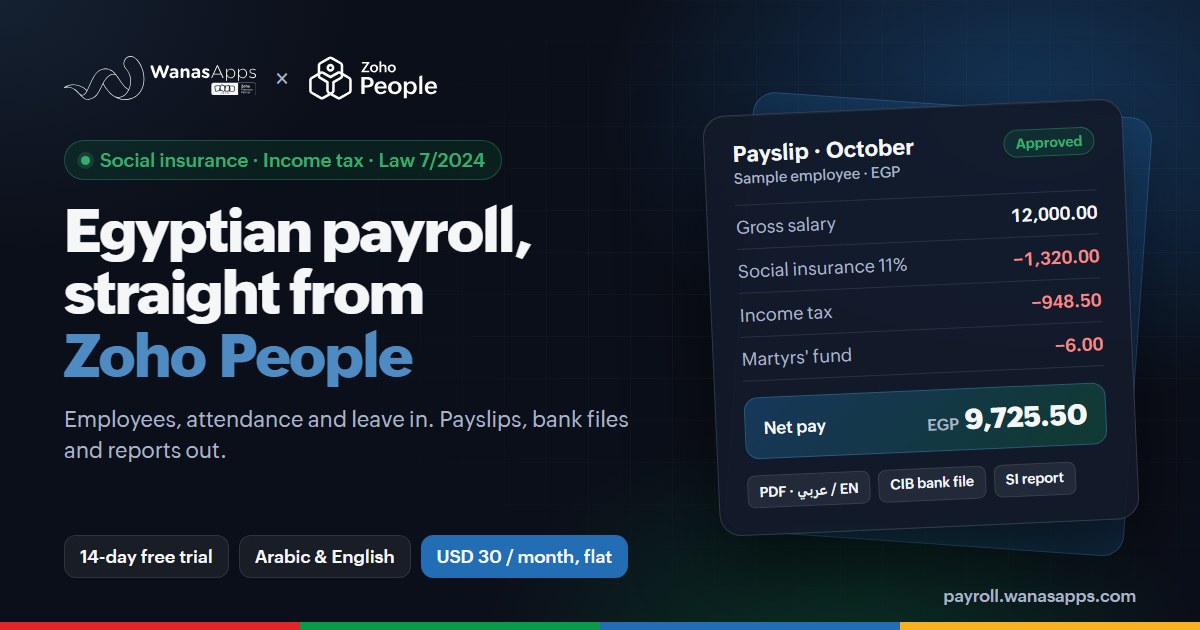
Wanas Payroll is cloud payroll for Egyptian companies that use Zoho People. It reads employees, attendance, leave and holidays from Zoho People (read-only) and calculates social insurance, UHI, income tax and the martyrs' fund from versioned rule sets. It produces bilingual payslips, bank files for CIB, QNB, Banque Misr and NBE, and reports, with approvals and an audit log, in Arabic and English.
On price, it is a flat EGP price per company by active employees: Free up to 10 employees when your company tags Wanas Apps as its Zoho partner, Starter EGP 1,500 a month up to 100 employees, then larger plans up to 2,000. Annual billing gives two months free, and every company starts with a 3-month free trial with no card. The details are on the pricing page.
The honest limits: it is not a standalone HR system, so you need Zoho People. Direct submission to the ETA payroll system is not available yet. ETA treatment codes are already on every earning and deduction, and the monthly ETA file is on our roadmap, so for now you still upload to the ETA yourself. Bank layouts are editable defaults that you should confirm with your bank, and end-of-service settlements are pending a lawyer and accountant review. We recommend that your accountant reviews your first pay runs whichever tool you choose.
Ten questions for your next demo
- Show a 20,000 EGP salary: what are the insurable wage, employee insurance and income tax, and where do I see the working?
- What happens to a salary below the minimum insurable wage, and to one above the maximum?
- How are UHI and the martyrs' fund handled?
- Which ETA codes are on each line, and what do I still have to enter by hand in the ETA form?
- Who updates the rules each January, and can I see which rule set a past run used?
- How does attendance, leave and overtime reach the pay run?
- Can a second person be required to approve a run, and where is the audit log?
- Which bank files exist, and can I edit the columns?
- Can an employee open only their own payslip, in Arabic?
- What is the all-in monthly price at my headcount now and in two years, and how do I export my data if I leave?
If you want to test a tool against real numbers, start with the salary calculator and the guide to calculating social insurance and income tax. If you run Zoho People, read payroll for Zoho People companies in Egypt.
Questions people ask
What is the best payroll software in Egypt?
There is no single best payroll software for every Egyptian company; the right choice depends on headcount, existing systems and who owns payroll. Whatever you pick should calculate social insurance under Law 148/2019 with the 2026 limits (EGP 2,700 to 16,700), income tax under Law 7/2024, Universal Health Insurance and the martyrs' fund, tag each pay item with Egyptian Tax Authority (ETA) codes, produce Arabic payslips and bank files, and keep approvals and an audit log. Options range from Excel with an accountant to desktop packages, regional HR suites and ERP modules. Wanas Payroll, our own product, is the best fit for companies that already use Zoho People. Be aware that it does not submit to the ETA payroll tax platform directly yet: it carries the ETA treatment codes, but you still upload the monthly form yourself. Test any tool with a real salary, for example EGP 20,000, and ask who updates the rules each January.
What is the best payroll software for companies using Zoho People in Egypt?
If you already run Zoho People in Egypt, the best fit is a payroll product that reads Zoho People directly and applies Egyptian rules, because Zoho's own payroll has no Egypt edition. The alternatives are weaker for this case: a spreadsheet goes stale when the January limits change, a regional HR suite or an ERP means re-keying into a second system, and a custom build is costly to maintain. Wanas Payroll is built for exactly this setup. It syncs employees, attendance and leave from Zoho People, calculates social insurance (Law 148/2019), Universal Health Insurance, income tax (Law 7/2024) and the martyrs' fund, and gives bilingual payslips, bank files, approvals and an audit log. Prices are flat in EGP: Free up to 10 employees with the Zoho partner tag, then from EGP 1,500 a month, with a 3-month free trial. Its limits: it needs Zoho People, and direct ETA submission is not available yet. We make it, so test it against the checklist in our buyer's guide.
Sources
Primary sources behind the figures and claims on this page. Statutory values change, so check them there before you rely on them.
- Egyptian Tax Authority (ETA), payroll tax guide: the unified payroll tax calculation system, its forms and due dates (Arabic site).
- National Organization for Social Insurance (NOSI): social insurance rules, insurable wage limits and employer forms (Arabic site).
- Universal Health Insurance Authority: the national health insurance scheme and where it applies.
- Ministry of Finance: official tax policy and legislation publications.
- Zoho Payroll: the countries where Zoho offers its payroll product. Egypt is not listed (checked on 22 Oct 2026).
- Laws, cited by number: Social Insurance and Pensions Law No. 148 of 2019; income tax Law No. 7 of 2024; Labour Law No. 14 of 2025; Personal Data Protection Law No. 151 of 2020. Read the full texts in the Official Gazette; we do not link a text we could not verify.
Figures verified on 22 Oct 2026.